Launch offer — valid today only

📄 Digital book in PDF · read it on your phone or print it

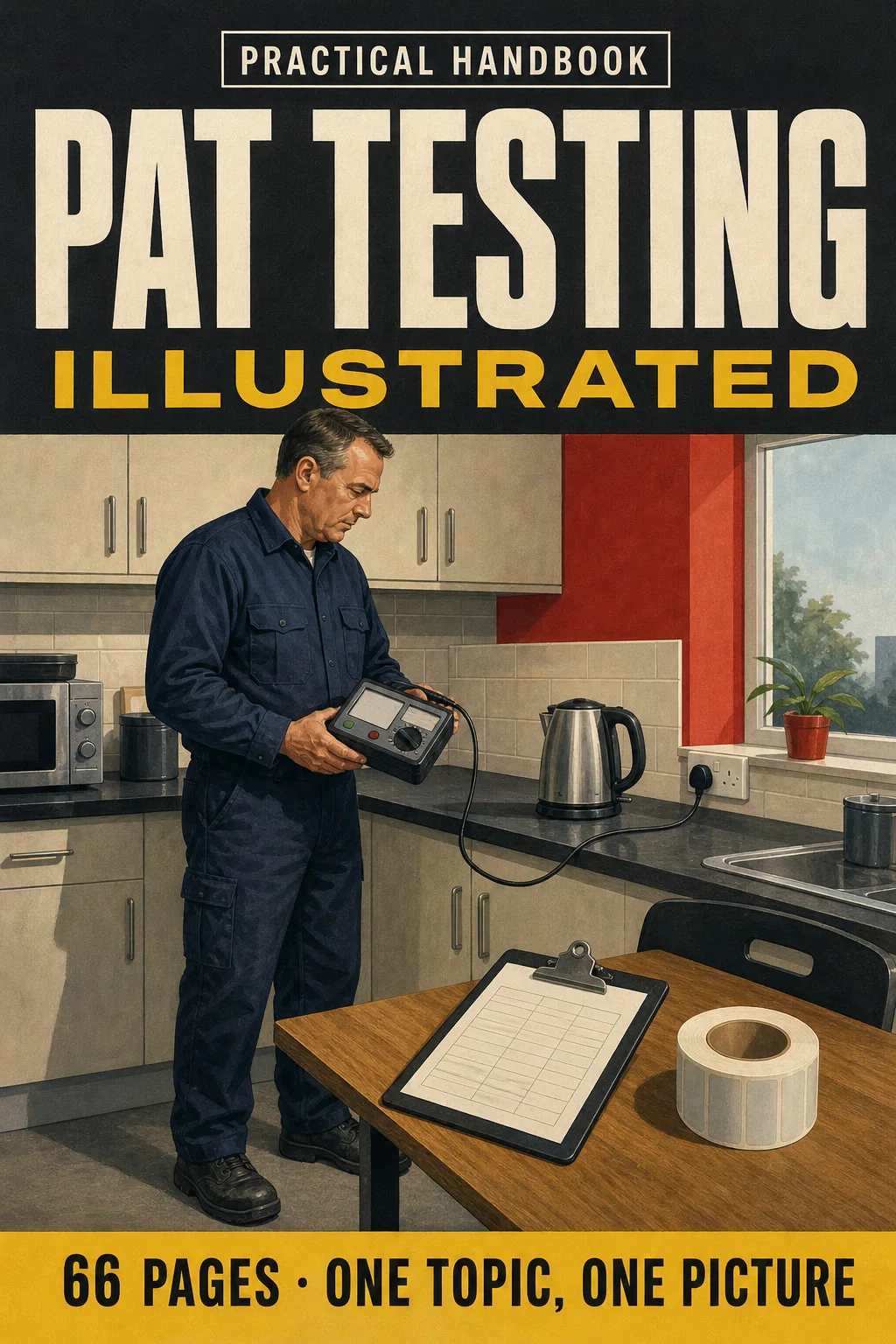
PAT Testing and the 2377-77 Exam, Illustrated Every Test in the Same Order

Equipment classes, the plug inside out, earth continuity, insulation resistance, leakage tests, portable RCDs, pass or fail, labels and records. Every topic has its own page: the drawing first, then what you need to remember. 66 illustrated pages.

START STUDYING THIS WAY

🔒 Secure checkout · PDF by email · 30-day guarantee

Every topic, its own pageEvery test drawn, with the explanation beside it
66 illustrated pages9 parts, from why we inspect and test to the whole method on one page
Up-to-date sourcesIET Code of Practice (5th ed.), Electricity at Work Regulations 1989 and HSE HSG107
PDF by emailFormat

Look Inside the Book

Every page has one big drawing and a box with the limits and steps you need to know:

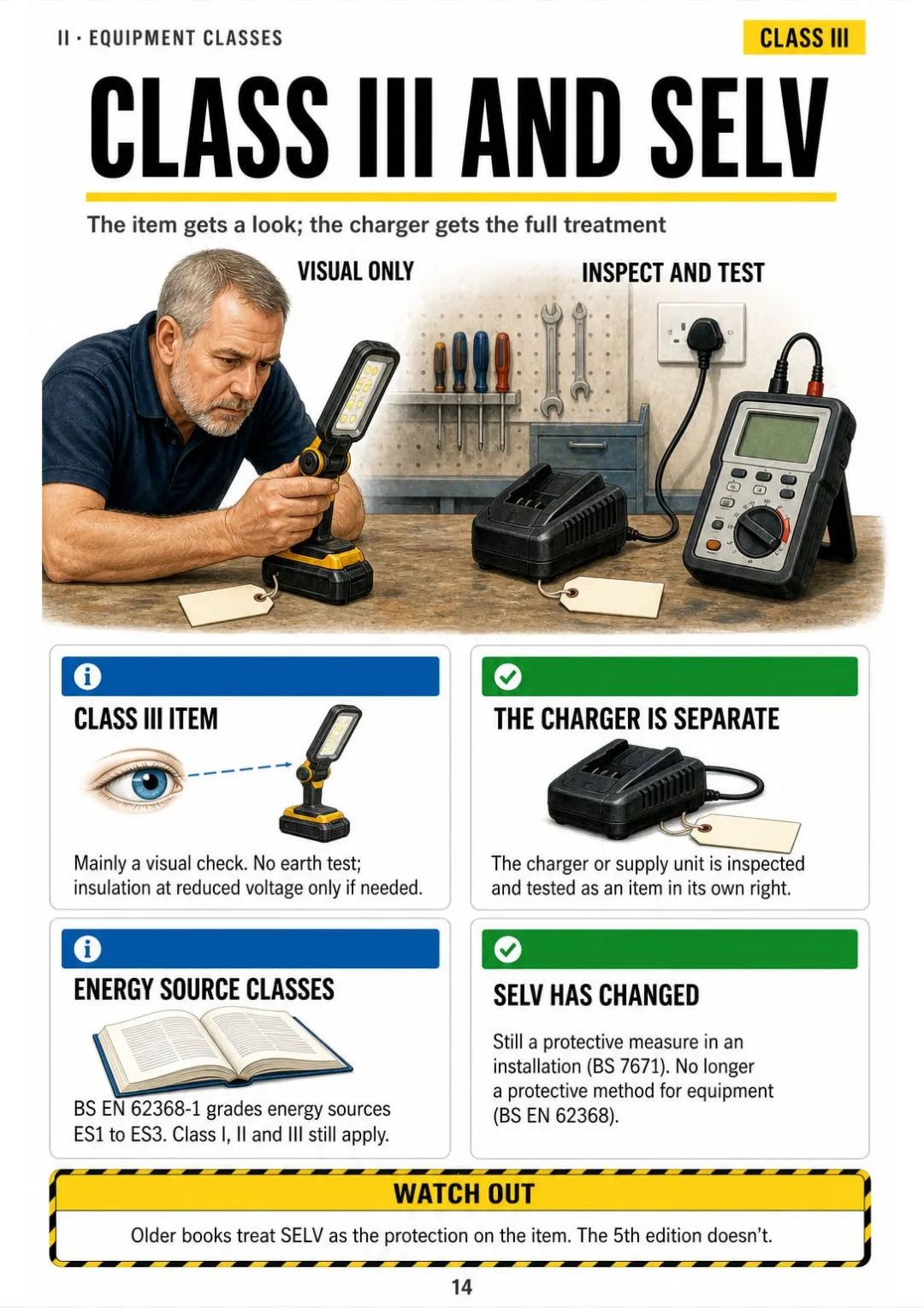
Class III: visual inspection only. The charger is inspected and tested as its own item.
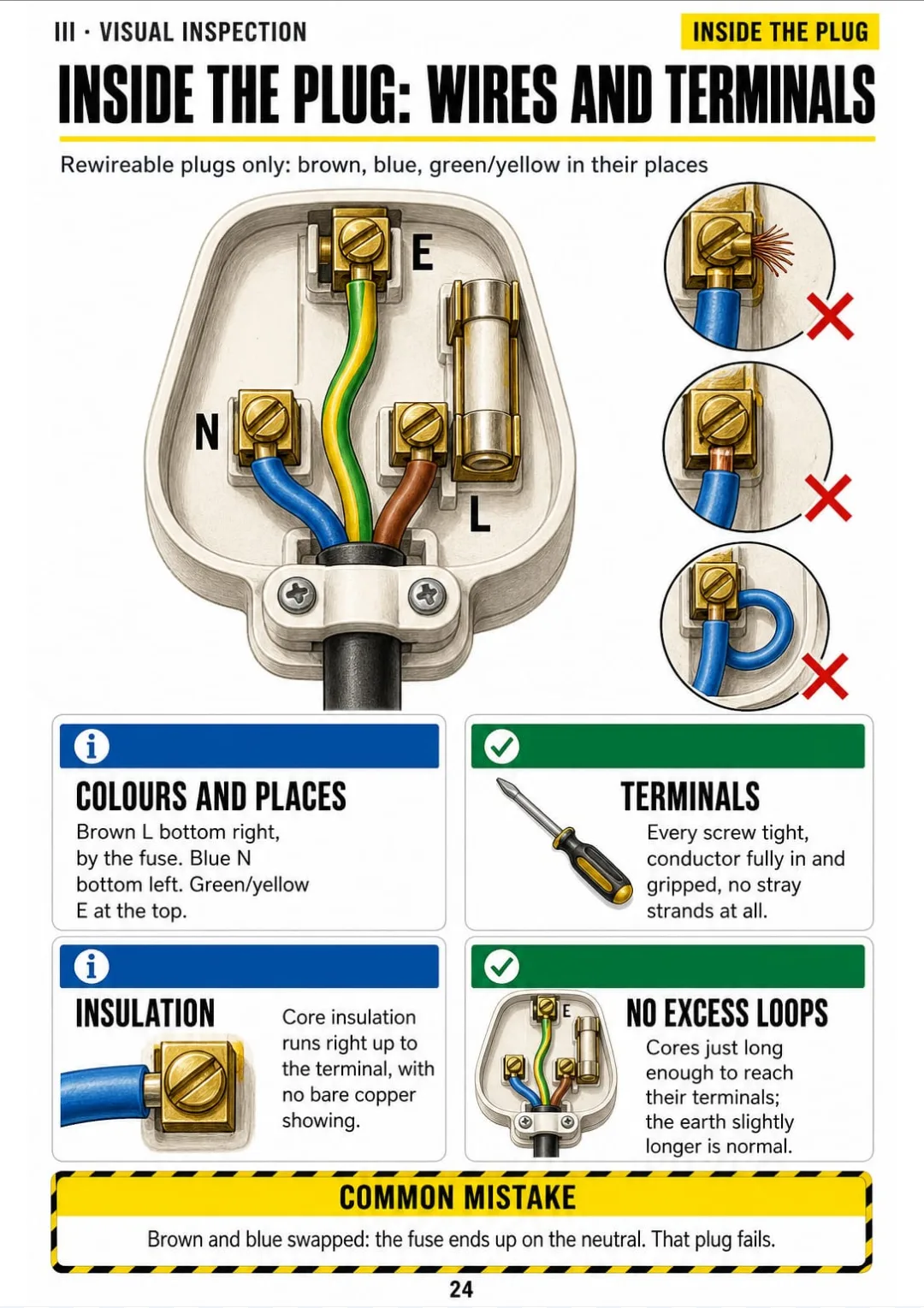
Brown L by the fuse, blue N left, green/yellow E top, terminals tight.
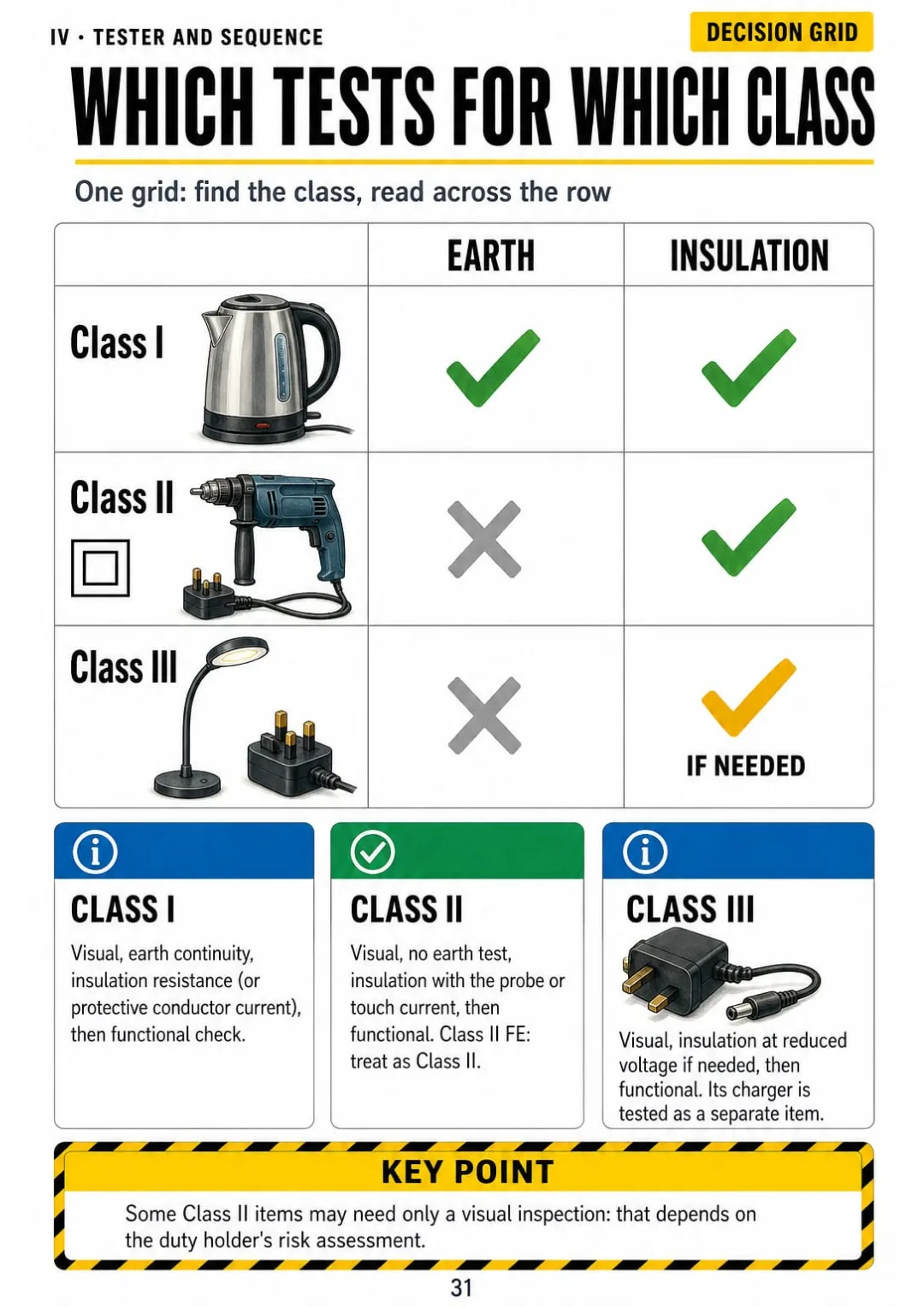
Class I four checks, Class II no earth test, Class III visual, functional, insulation if needed
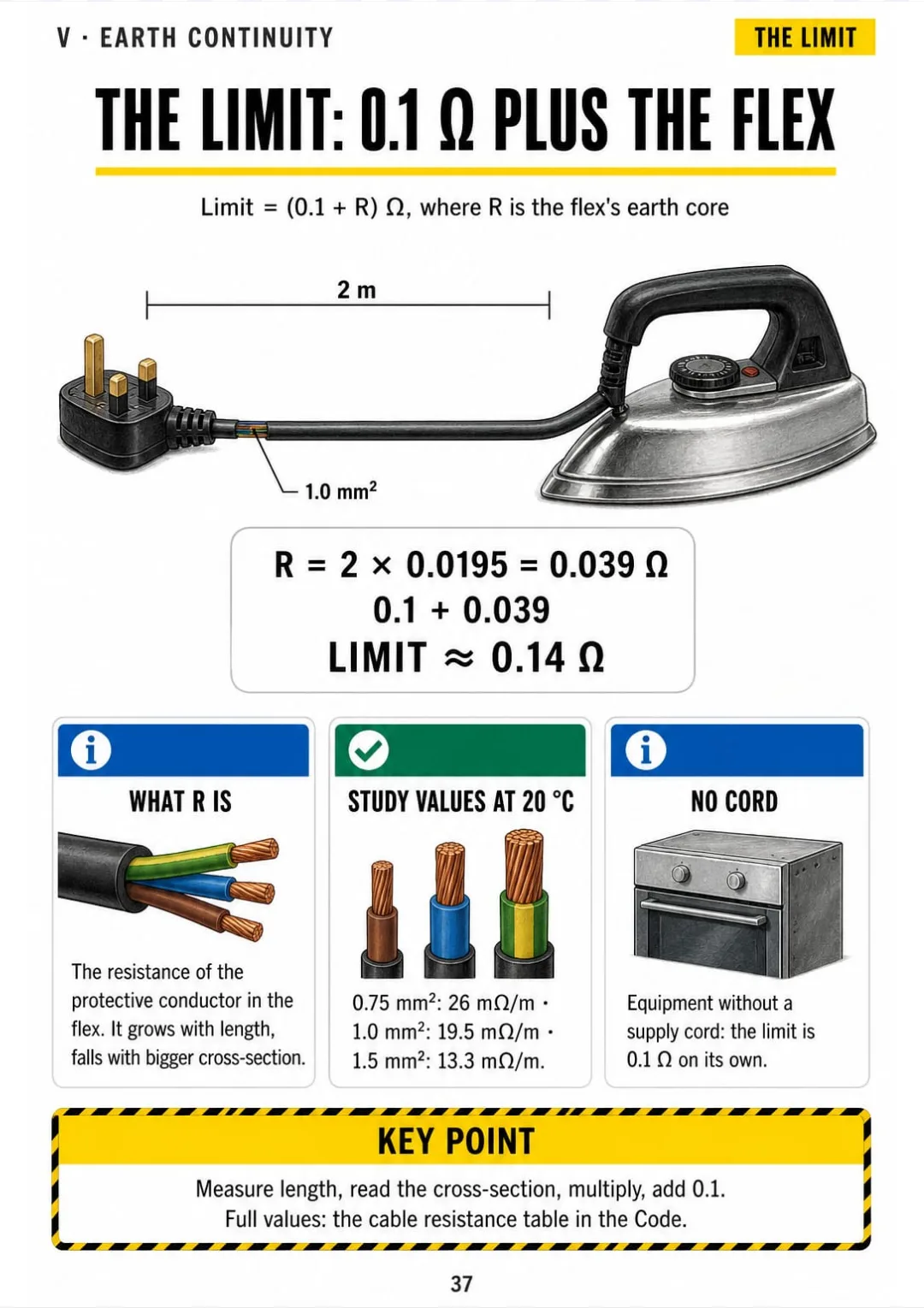
2 m of 1.0 mm² flex: 0.1 + 0.039 = a limit of about 0.14 Ω
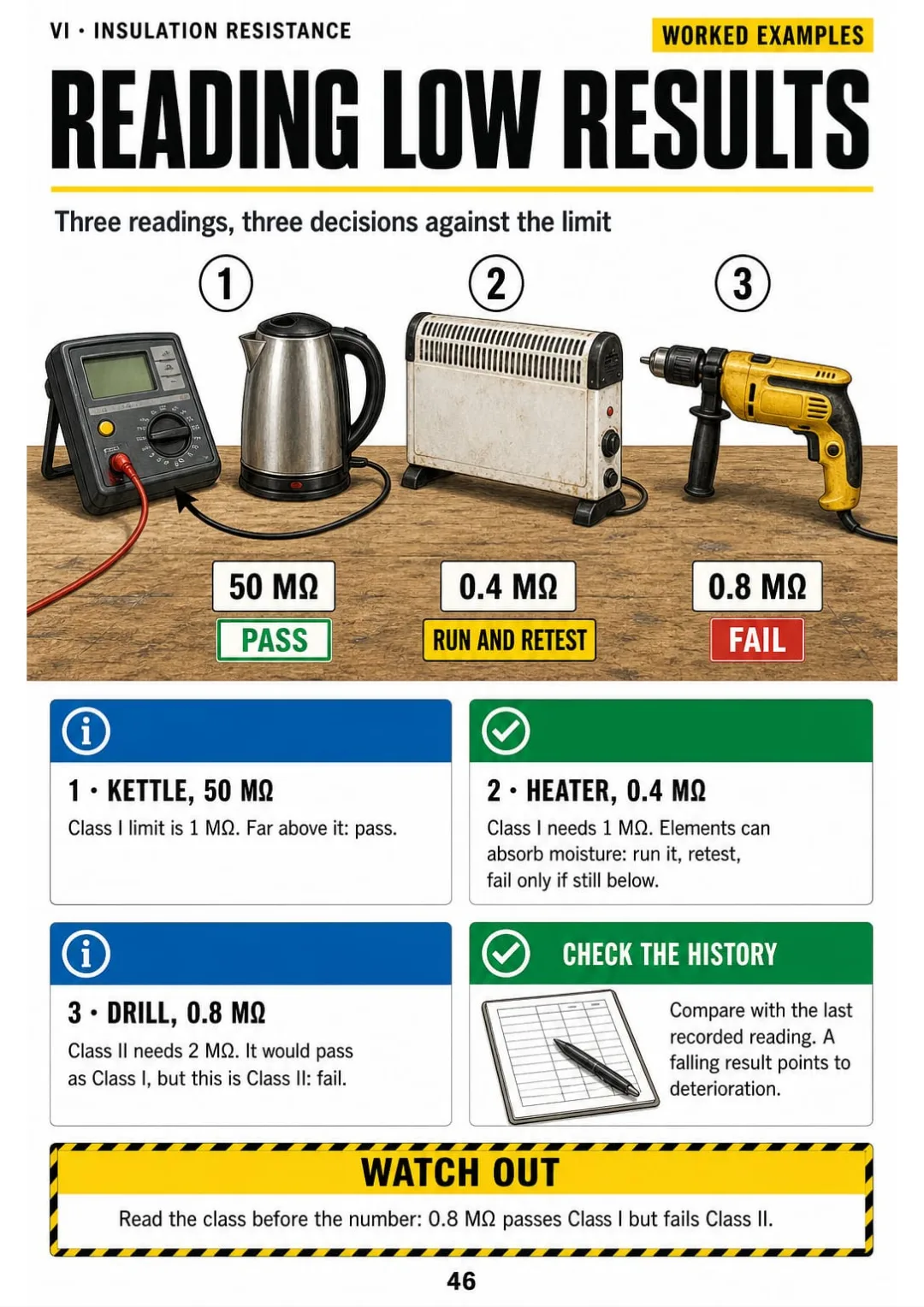
50 MΩ pass · 0.4 MΩ heater: run, retest, then decide · 0.8 MΩ Class II fail.
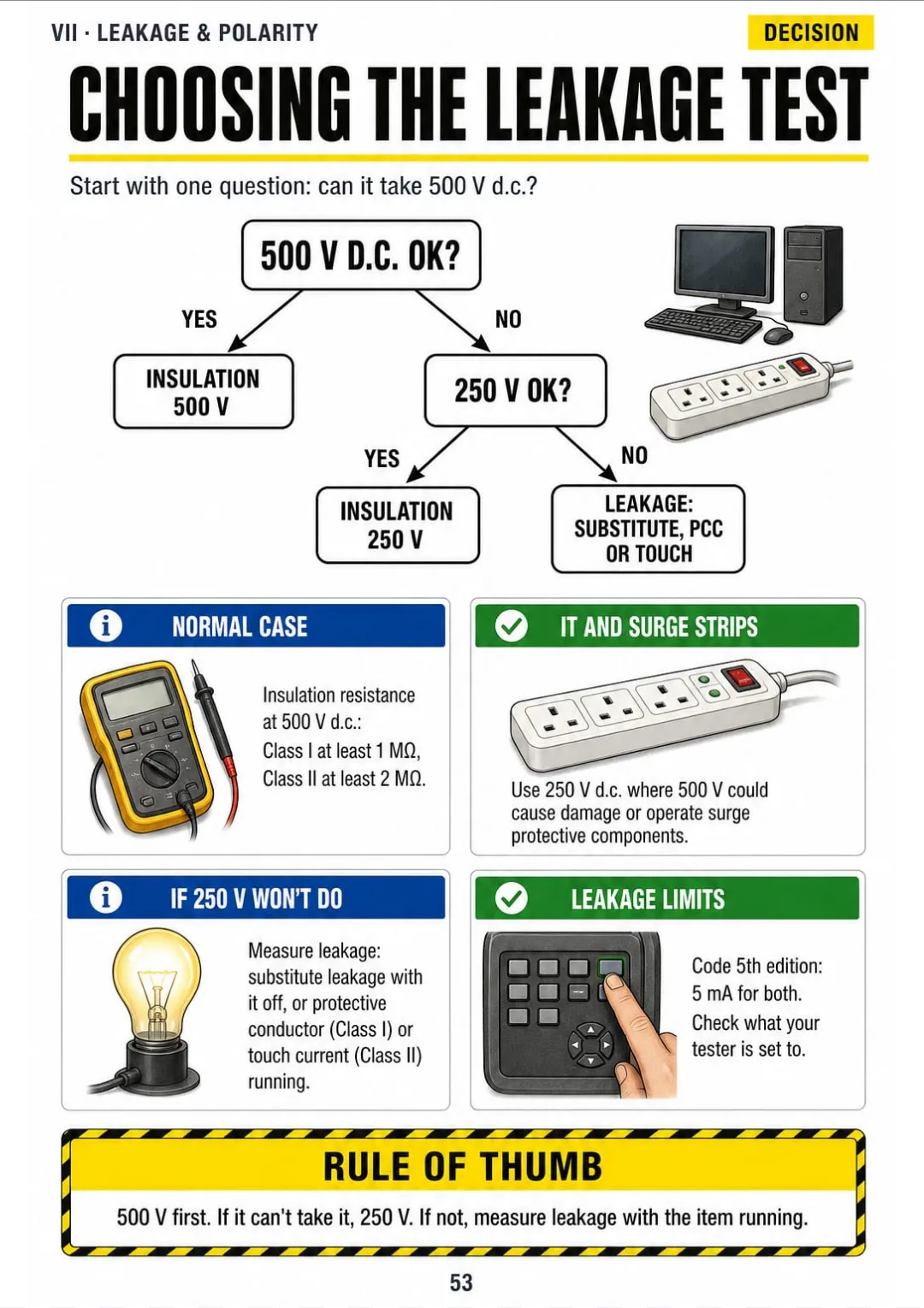
Decision flowchart: 500 V → 250 V → protective conductor or touch current, by class.
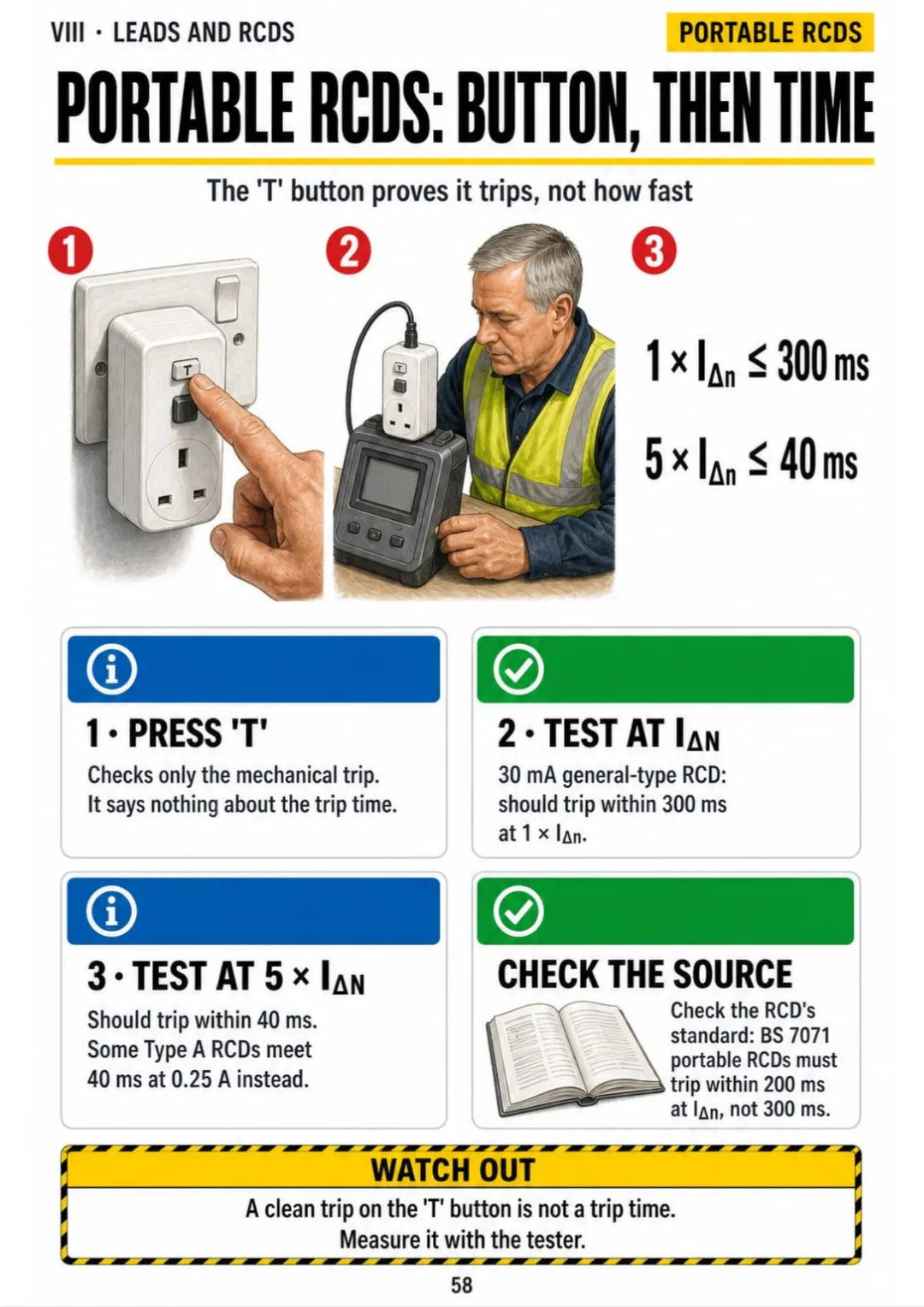
30 mA portable RCD: within 300 ms at 1 × IΔn, within 40 ms at 5 × IΔn
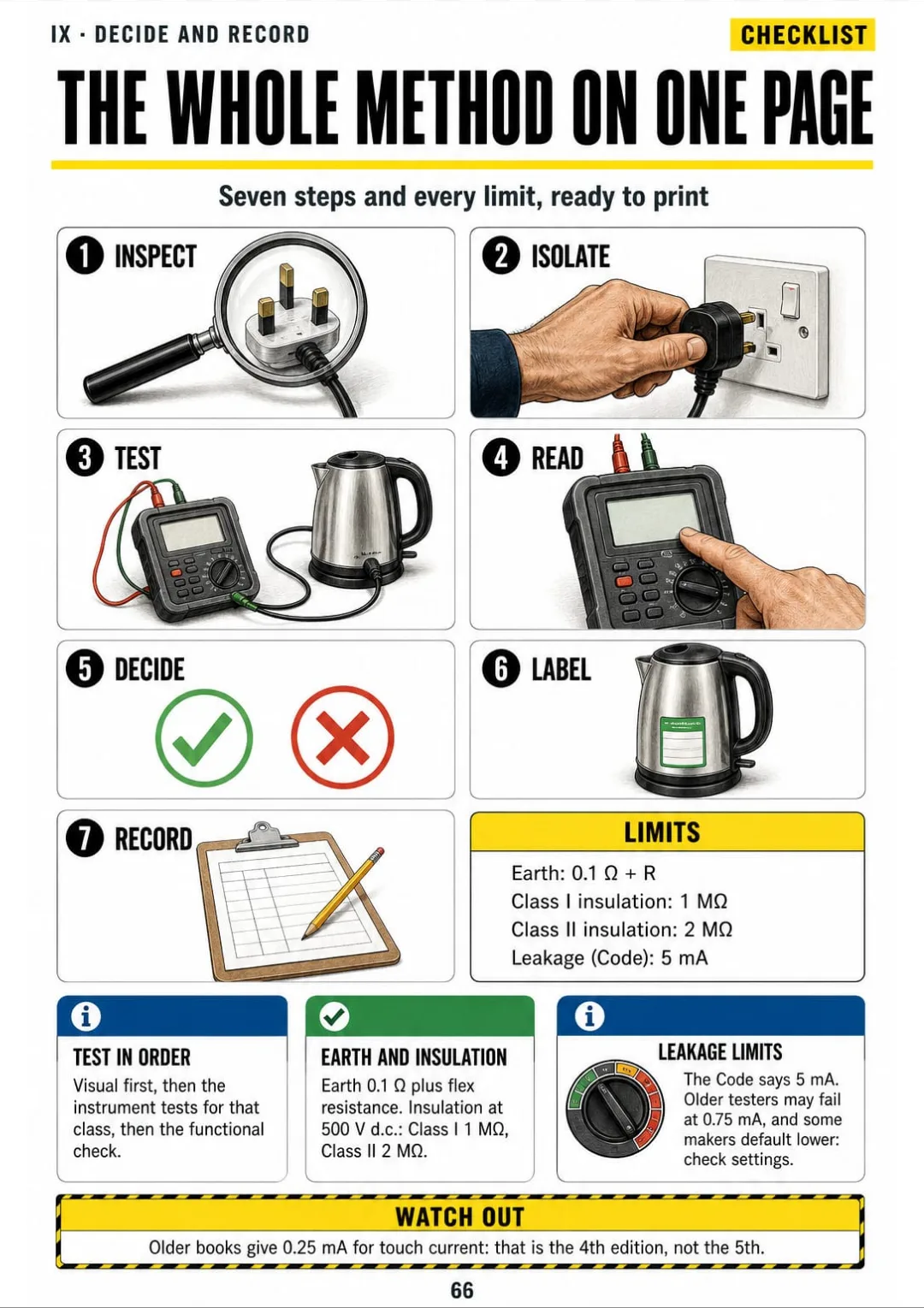
Seven steps and every limit on one printable card

Swipe to see more →

These are real pages from the book. The table of contents is the full one: 9 parts and 62 topics.

The Problem Isn't You. It's How It Was Explained.

You're at a desk with a Class II drill in one hand and the tester leads in the other, and you can't remember whether this one gets an earth continuity test.

You did read it. But the Code of Practice sets out which tests go with which class in long paragraphs, with the exceptions tucked in between, and by the next evening the classes have blurred into one.

Class I four checks, Class II no earth test, Class III visual, functional, insulation if needed

In the book, that's one page. Class I, Class II and Class III sit side by side, each with its own drawing: four checks for Class I, no earth test for Class II, visual and functional for Class III, with insulation only where needed.

Plug wiring, the earth continuity limit, the insulation limits, choosing the leakage test and portable RCD trip times work the same way: each one has a page of its own.

You read the label, you know which tests apply, and you get on with the job without going back to the manual.

COMPARE FOR YOURSELF

The Same Topic, Two Ways to Study It

THIS
  • The manual: line after line
  • Plug wiring explained only in words
  • You reach the exam still unsure
When the plug is opened for inspection, it shall be verified that the line conductor, identified by brown insulation, is connected to the terminal associated with the fuse carrier; that the neutral conductor, identified by blue insulation, is connected to the left-hand terminal when viewed from the rear with the cover removed; and that the protective conductor, identified by green-and-yellow insulation, is terminated at the uppermost terminal, all terminal screws being adequately tightened, with no stray strands or excessive bare conductor present.
FOR THIS
  • The open plug in one drawing
  • The colours and terminals in a box
  • You see it and you get it
Brown L by the fuse, blue N left, green/yellow E top, terminals tight.
CONTENTS

Take a Look at the 9 Parts and 62 Topics

Why we inspect and test, equipment classes, visual inspection, the tester and the test order, earth continuity, insulation, leakage and polarity, leads and RCDs, and deciding, labelling and recording: 66 pages, all illustrated

IWhy we inspect and test · pp. 5-11
  1. What 'in-service inspection and testing' really means
  2. The law behind it: maintain, don't just test
  3. Who carries the duty
  4. Competence: what makes you the right person
  5. Most faults are found by looking
  6. The method in 7 steps
  7. How the 2377-77 exam is set out
IIEquipment classes and types · pp. 12-19
  1. Class I: basic insulation plus an earth
  2. Class II: double or reinforced insulation
  3. Class III and SELV
  4. Class 0 and Class 0I: what to do if you find one
  5. Telling Class I from Class II in 10 seconds
  6. Equipment types: from hand-held to fixed
  7. IT equipment and why it's handled differently
  8. Extension leads, multiway adaptors and IEC leads
IIIUser checks and formal visual inspection · pp. 20-28
  1. User checks: what the user looks for
  2. Formal visual inspection: what makes it 'formal'
  3. Before you touch: isolate and ask the user
  4. Inspecting the plug from the outside
  5. Opening the plug: wiring and terminals
  6. The cord grip: on the sheath, never on the cores
  7. The fuse: right type, right rating
  8. The flex and the appliance body
  9. Suitability and environment
IVThe tester and the test sequence · pp. 29-34
  1. Inside the PAT tester: what each socket and lead does
  2. Checking your tester before you start
  3. Which tests, for which class
  4. The order of tests, and why it matters
  5. Pass/fail on the screen versus your own decision
  6. Your own safety while testing
VEarth continuity · pp. 35-40
  1. What the earth continuity test proves
  2. Hard test or soft test: 20-25 A versus 100-200 mA
  3. The limit: 0.1 Ω plus the resistance of the flex
  4. Where to put the clip
  5. Flex the cord during the test
  6. Reading the result: three worked examples
VIInsulation resistance · pp. 41-46
  1. What the insulation test proves
  2. The limits: Class I 1 MΩ, Class II 2 MΩ
  3. Class II: test with the probe
  4. The switch must be ON
  5. When not to use 500 V
  6. Reading low results: fault or moisture?
VIILeakage, polarity and functional checks · pp. 47-53
  1. Protective conductor current: Class I
  2. Touch current: Class II
  3. Substitute leakage: when it's useful
  4. Differential leakage: measuring with the item running
  5. Polarity: L and N the right way round
  6. The functional check
  7. Choosing the leakage test: a decision page
VIIILeads, RCDs and site equipment · pp. 54-59
  1. Extension leads: three tests and the limit
  2. Cable reels: unwind them fully
  3. IEC leads (kettle leads)
  4. Multiway adaptors and surge-protected strips
  5. Portable RCDs: test button and trip time
  6. 110 V site equipment
IXDecide, label, record and revise · pp. 60-66
  1. Pass or fail: the decision in 4 questions
  2. After a fail: quarantine, tell, repair or scrap
  3. Labels: what goes on them
  4. The equipment register
  5. The test record and the fault report
  6. Intervals: based on risk, not a fixed year
  7. The whole method on one page

One Page, One Topic, All Clear

Think of it this way:

You're in an office with forty items to get through and a kettle in front of you. You need the earth continuity limit for that flex, right now, not after twenty minutes with the manual.

In the book you open the page on the limit and you see 0.1 Ω plus the flex, worked out on 2 m of 1.0 mm² cable: about 0.14 Ω, drawn next to the plug and the clip.

50 MΩ pass · 0.4 MΩ heater: run, retest, then decide · 0.8 MΩ Class II fail.

Class I and Class II, the plug wiring, low insulation readings, the leakage flowchart and portable RCDs are set out the same way: one topic, one page, one drawing.

PAT Testing Illustrated is 9 parts and 62 topics, all drawn, and it ends with the whole method and every limit on one printable page.

What you see drawn, you don't have to memorize.

What's Inside PAT Testing Illustrated:

Ipp. 5-11

Why we inspect and test

What in-service inspection and testing really means, the law behind it, who carries the duty and what competence asks of you, so you know what you're signing for. Why most faults are found by looking, the 7-step method you'll follow on every item and how the 2377-77 exam is set out.

IIpp. 12-19

Equipment classes and types

Class I, Class II, Class III and SELV, Class 0 and 0I, telling Class I from Class II in 10 seconds, equipment types, IT equipment, extension leads and IEC leads.

IIIpp. 20-28

User checks and formal visual inspection

User checks, what makes a visual inspection formal, isolating and asking the user, the plug outside and inside, the cord grip, the fuse, the flex, the body and the environment.

IVpp. 29-34

The tester and the test sequence

Inside the PAT tester, checking it before you start, which tests for which class, the order of tests, the screen's pass/fail versus your decision, and your own safety.

Vpp. 35-40

Earth continuity

What the earth continuity test proves, hard or soft test, the 0.1 Ω plus flex limit, where to put the clip, flexing the cord and three worked readings.

VIpp. 41-46

Insulation resistance

What the insulation test proves, the 1 MΩ and 2 MΩ limits, testing Class II with the probe, the switch ON, when not to use 500 V and reading low results.

VIIpp. 47-53

Leakage, polarity and functional checks

Protective conductor current, touch current, substitute and differential leakage, polarity, the functional check and a decision page for choosing the leakage test.

VIIIpp. 54-59

Leads, RCDs and site equipment

Extension leads and their limit, cable reels, IEC leads, multiway adaptors and surge-protected strips, portable RCDs and their trip times, and 110 V site equipment.

IXpp. 60-66

Decide, label, record and revise

Pass or fail in 4 questions, what to do after a fail, labels, the equipment register, test records and fault reports, risk-based intervals and the whole method on one page.

At the end of the book: The 7-step method and every limit on one printable page.
Plus: 2 Free Books

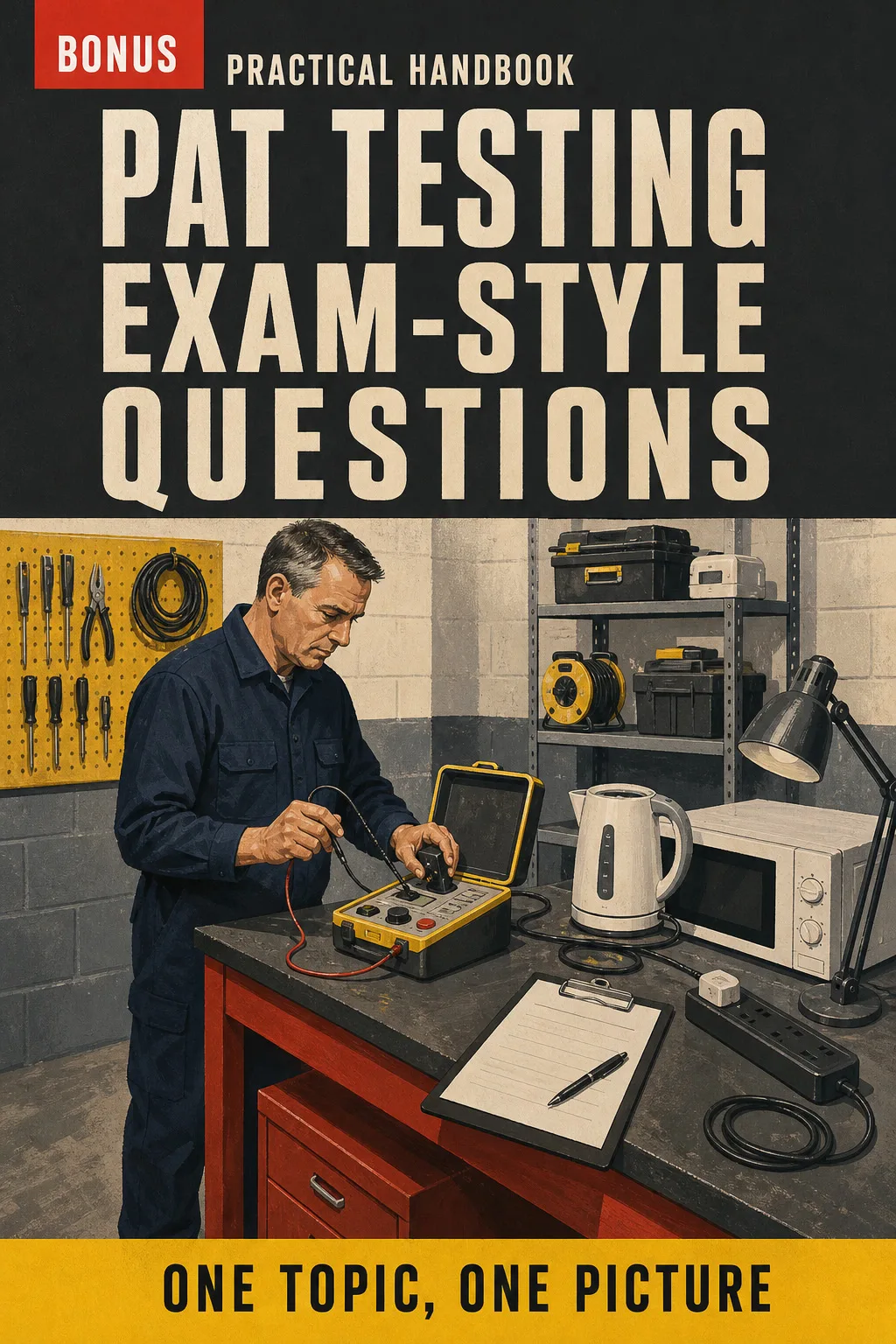
PAT Testing Exam-Style Questions

BONUS 1: «PAT Testing Exam-Style Questions»

Value on its own: US$ 17.90

Multiple-choice practice in the style of the online exam, with every answer explained, so you find the gaps before the exam does.

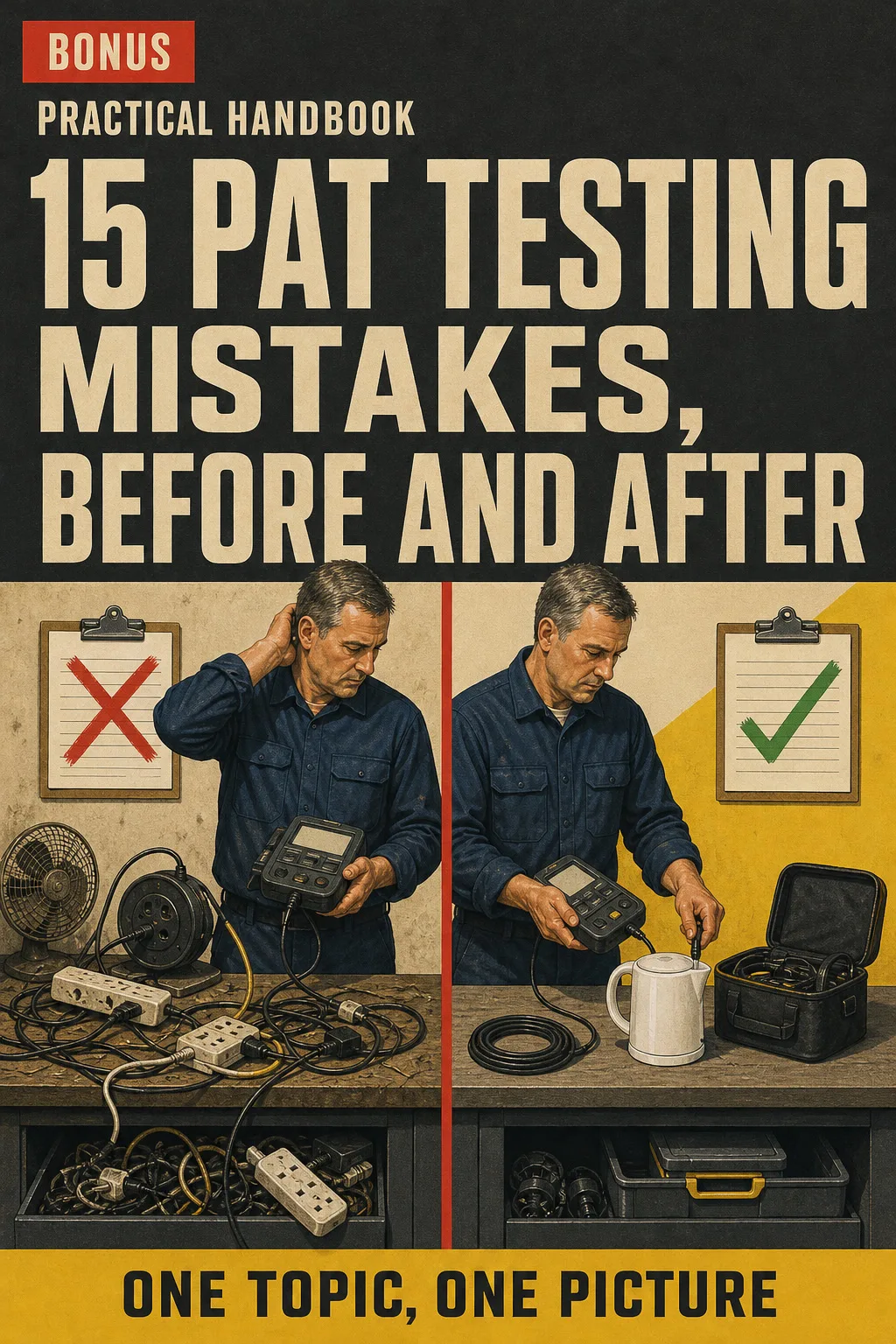
15 PAT Testing Mistakes, Before and After

BONUS 2: «15 PAT Testing Mistakes, Before and After»

Value on its own: US$ 14.90

The most frequent mistakes in inspection, testing and recording, each drawn wrong and then right, to revise in one evening.

PAT Testing Illustrated with 2 Free Books

  • PAT Testing Illustrated: 66 illustrated pagesUS$ 63
  • BONUS 1: PAT Testing Exam-Style QuestionsUS$ 17.90
  • BONUS 2: 15 PAT Testing Mistakes, Before and AfterUS$ 14.90
  • High-resolution PDF to printIncluded
Total value US$ 95.80
YOUR PRICE:
US$ 27
You save US$ 68.80
YES, I WANT PAT TESTING ILLUSTRATED FOR US$ 27

📄 This is a digital PDF book sent to your email: nothing is printed or shipped.

Secure purchaseEncrypted payment30-day guarantee

PDF by email: We email you PAT Testing Illustrated as a PDF, together with the two free books. It's a single payment: no installments, no extra charges.

Who This Book Is For

You're studying PAT testing

You're studying PAT testing

Each test has its own page and its own drawing, so the classes and limits stay apart instead of blurring together.

Your 2377-77 exam is coming up

Your 2377-77 exam is coming up

You revise the method in the same order every evening and check yourself with the exam-style questions.

You already do the testing

You already do the testing

Print the pages you need and keep the whole method on one card next to the tester, from the first plug to the record sheet.

Everything You Get Today

US$ 95.80US$ 27
YES, I WANT PAT TESTING ILLUSTRATED FOR US$ 27

📄 This is a digital PDF book sent to your email: nothing is printed or shipped.

30DAYS
GUARANTEE

30-Day Guarantee

Try PAT Testing Illustrated for 30 days, bonus books included.

We refund everything if the file won't open, if the book isn't what you see here, if you were charged twice or if the email doesn't arrive. Just email us.

You pay once. No subscriptions.

Frequently Asked Questions

Is it for me if I've been handed PAT testing at work, or I'm adding it to my electrical work?

Yes. It starts from why we test and goes all the way to limits, leakage tests and records. If you already do electrical work, the parts that take time are still there: substitute versus differential leakage, low insulation readings, IT equipment, 110 V site kit and risk-based intervals, each with its own page and its own decision.

Where does the content come from?

It follows the current IET Code of Practice for In-service Inspection and Testing of Electrical Equipment (5th edition), the edition the 2377-77 is built around, plus the Electricity at Work Regulations 1989 and HSE guidance HSG107. Everything is explained in our own words and drawings, with no text copied from the Code.

Is it official material?

No. It's an independent illustrated study book, not published, approved or endorsed by City & Guilds, the IET or the HSE. It doesn't give you a certificate: the qualification comes from passing the 2377-77 assessments with an approved centre.

Does it replace the course or the training?

No. For the practical you still need an approved course and hands-on time with a tester. What the book gives you is the order to follow at the bench: which tests for the class, where the clip goes, flexing the cord, reading a low result and deciding pass or fail, so your hands aren't waiting on your memory.

Are the practice questions the ones in the exam?

No. The questions are written for this book in the style of a multiple-choice exam. They aren't official exam questions.

When and how does it arrive?

As a PDF by email, to the address you enter at checkout.

Do I have to pay every month?

No. It's a one-off payment, with no subscription.

Can I have it on paper?

Yes. The PDF is made to print, so you can print the whole book or just the pages you want to keep with the tester.

How does the refund work?

You have 30 days. We refund everything if the file won't open, if the book isn't what you see on this page, if you were charged twice or if the email doesn't arrive: just email us.

Before You Close This Page

No more rereading with nothing sticking.

Which test goes with which class: you see it drawn, and that's it.

You reach the exam, or the job, knowing where everything is.

Drawings make studying faster.

The book is right below.

One-time payment: US$ 27 · Guarantee: 30 days · PDF by email

YES, I WANT PAT TESTING ILLUSTRATED FOR US$ 27

📄 This is a digital PDF book sent to your email: nothing is printed or shipped.